〔註:這篇論文是我多年來,悉心研究「中國歷史」與「氣候變遷」的一些心得,為求審慎負責並便予更多的國際同好、學者、專家分享,謹以英文期刊論文的格式書寫。對於習於中文的讀者,我將於往後的「部落格」文中,以「科普」的方式另予重新整理陳述,敬請期待並不吝惠予指正。〕
David D. Sheu
Institute
of Marine Geology and Chemistry, National Sun Yat-Sen University, Kaohsiung
804, Taiwan, Republic of China
Disastrous climate change accompanying prolonged
droughts has been considered to play a key role in the collapse of human
societies and ancient civilizations. By using well-documented historic
records and superimposing the years of the rises and falls of all dynasties in
Chinese history on the reported temperature anomaly trend during the past two
millennia, I show that the successive change of dynasties in Chinese history is
no exception to this causative link and the entire history of China can be
viewed as a series of devastating climate oscillations in China. When temperatures plunged sharply from the norm, the
long-lived dynasties were all overthrown by rebellions, mostly peasants,
fleeing their homelands in search of food sources and shelters when
large-scale famine and chaos occurred under such devastating climate
conditions. The shorter-lived dynasties, which represent the most
turbulent periods in Chinese history, also all coincided with recurrent severe
droughts when temperatures dropped and consistently remained well below
the mean during prolonged cold episodes.
The case of China revealed in this study thus provides a real
example of the potential threat of disastrous climate change to current
and future societal stability and human civilizations.
The potential impact of continuing increases in
atmospheric CO2 on the future climate has been a subject of
intensive studies at different levels (IPCC, 2007). The abrupt and
disastrous changes in climate accompanying prolonged droughts have been shown
to play key roles in the downfall of ancient Akkadian, Andean, Mesopotamian and
Mayan societies and civilizations (Weiss et al., 1993; Hodell et al., 1995;
Binford et al., 1997; Cullen, et al., 2000; deMenocal, 2001; Weiss and Bradley,
2001; Hauq et al., 2003). The recorded history of China spans more than 2800
years, and the years of the rises and falls of all dynasties in Chinese history
are well documented in chronological order (Feng, 2003; Kuo, 2003). Furthermore,
China retains a variety of instrumental meteorological information sources,
including the Local Chronicles, the Official Weather Reports and the Official
Historical Documents, which can be used to identify extreme climatic events and
help establish semi-quantitatively the overall climate variability in China
(Wang and Zhang, 1988; Zhang and Crowley, 1989; Zhang, 1991; Song, 2000; Qian
and Zhu, 2002; Ge et al., 2003; Qian et al., 2003). Studies of paleoclimate proxy records derived
from ice cores, tree rings, lake sediments, peat cellulose and laminated
stalagmites provide further evidence of climate variations in China during the preceding
2-3 millennia (Lin et al., 1995; Sun et al., 1998; Sun, 2000; Wang and Gong,
2000; Wang et al., 2001; Hong et al., 2001; Yang et al., 2002; Paulsen et al.,
2003; Tan et al., 2003; Xu, 2003; Yang et al., 2004).
Most of these studies however emphasize only
climate fluctuations (mainly cold vs. warm temperatures and/or drought vs.
flood) and broad temperature variation trend in China with scant attention to
the impact of recurrent disastrous climates on the rise and fall of all dynasties
throughout the full history of China. Here I use historic documents and superimpose
the years of the rise and fall of each dynasty in Chinese history on the
reconstructed “weighted” temperature anomaly trend (Yang et al., 2002) in China
during the last two millennia to show that the successive changes of dynasties in
Chinese history are, with no exceptions, coherent with a series of disastrous
climate events in China, and that the entire history of China can be compiled in
the context of disastrous climate changes in China.
Prehistory of China (pre-Qin dynasty)
A
sketch of the
important historic and climate-mediated events during the ancient Chinese
history from 0 to 3,000 BC is presented chronologically in Figure 1. From 4,500 to 3,000 BP, the region along the
bank of Huanghe (Yellow River) continued basking in the mild weather, and the
first Chinese Kingdom, i.e., Huang-Te, was founded in 2,697 BC (the year
generally regarded as the commencing year of Chinese history) (Feng, 2003; Kuo,
2003). After some 600 years of turmoil, the first dynasty of the Chinese empire,
i.e. the Xia dynasty, was established in 2,070 BC. During this period, Chinese
characters evolved from the earliest forms of hieroglyphs to
modern words. The first year documented by the Official Almanac was dated in
841 BC during the Western Zhou dynasty, and the famous ancient chronicle, the Autumn-Spring,
began documenting historical records from 722 BC during the Eastern Zhou
dynasty (Kuo, 2003). The entire history of China has been well documented in
script since then, and the years of the rise and fall of all successive
dynasties have been dated in chronological order. Studies of fossil pollens
reveal that, from 1,000 to 770 BC, during a cold period classified as the first
Chinese Little Ice Age (CLIA I) by paleoclimatologists, the temperature in
China plunged ~1.0 oC below average and many areas, including
Yangtze and Han rivers, became deeply frozen (Liu, 1994). A rapidly
deteriorating climate was evidenced by extended and repeated droughts (from 858
BC to 722 BC), and widespread crop failure and food shortage due to damage by
huge swarms of locusts were first reported in 707 BC (Kuo, 2003). These factors
led to prolonged violence from devastated peasants and invasion by the nomadic tribes
from the north (Hong et al., 2001; Yang et al., 2002), forcing the Western Zhou
dynasty to move eastward and ultimately succeed to the Eastern Zhou dynasty in
771 BC. According to historic records, the Eastern Zhou dynasty consisted of
two distinct periods: the Spring and Autumn Annals (771-475 BC) and the Warring
States Periods (475-221 BC). Historical documents further reveal that the
climate was generally warm and wet during the Spring and Autumn Annals.
However, towards the end of the period, the mild climate was punctuated by
severe droughts. Such hostile climate led to further intense conflicts among
various kingdoms and regional warlords and the Spring and Autumn Annals was ultimately
succeeded by the Warring States Periods.

Dynastic changes in Chinese history (from the Qin to the Qing dynasty)
The
fluctuating climate continued as the Qin dynasty rose to form the first unified
Chinese empire in 221 BC. Due to the continuously worsening climate and
widespread famine across the county, the Qin dynasty lasted merely 15 years despite
its dictatorial rule and was overthrown by rebellions led respectively by
Chenshan and Wukuang (Liu, 1994; Feng, 2003; Kuo, 2003). This was the first uprising
of devastated peasants (209 BC) against the ruling empire documented in Chinese
history (Fig. 1). During the Western Han (206 BC-AD 25) and the Eastern Han (AD
25-AD 221) dynasties, in addition to severe droughts and freezing temperatures,
the Chinese empire suffered from invasions of various nomadic tribes along the
northern border. The domestic turmoil and diplomatic wrangling together led to
the end of the Western Han (AD 25) and the Eastern Han (AD 221) dynasties. Historical
documents clearly record a large-scale famine (the Ginzhou famine) occurring in
AD 17 until the uprising of the Lulin-Chimei rebellion that ousted the Western
Han emperor in AD 25 (Kuo, 2003). From AD 109 to 194, severe weather conditions
continued and the Eastern Han dynasty was overthrown by a 20-year rebellion,
Huang-Jin, from AD 184 to 204. The Eastern Han dynasty collapsed in AD 221
(Fig. 2).
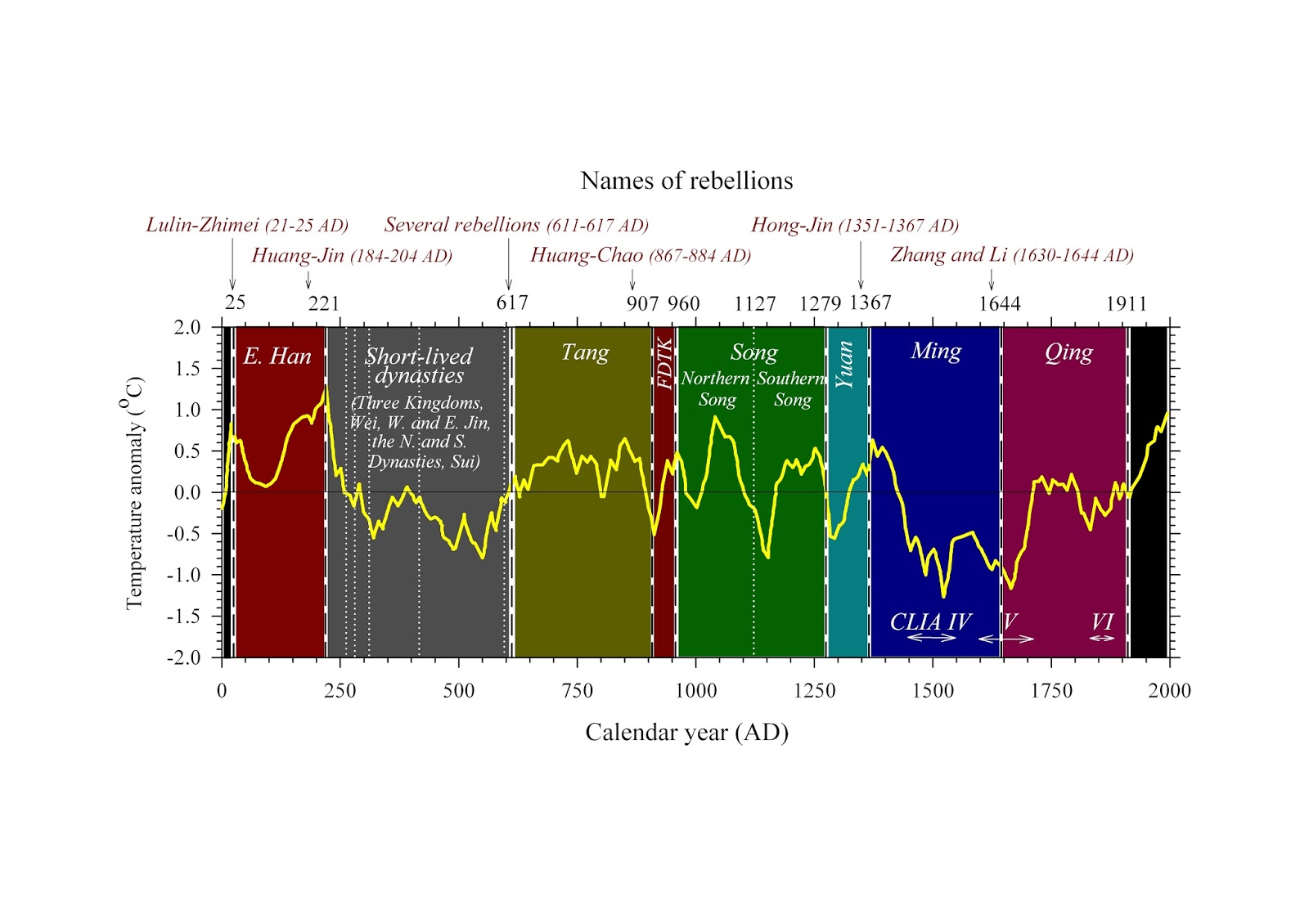
In this study, I superimpose the years of the rises
and falls of all dynasties since the Eastern Han on the “weighted” temperature
anomaly trend in China during the past two millennia as reconstructed by (Yang
et al., 2002) (Fig. 2). The composite trend is thought to best represent the
overall temperature variations in China because it is constructed by combining
multiple paleoclimate proxy records obtained from ice cores, tree rings, lake
sediments and historical documents, and takes into account the uneven spatial and
temporal distribution of proxy records. As depicted, temperatures in China were
above the mean between AD 0-250
with two peaks—one occurring around AD 25 and the other in AD 100-250—then
decreased rapidly and stayed mostly below the mean until AD 600. From AD 600 to
1400, temperatures in China are characterized by decadal to centennial
variability around the mean but the climate was noticeably punctuated with
several severe cold periods centered around AD 900, 1150, and 1300. From AD 1400
to 1920, China entered the so-called Little Ice Age period, with prominent cold
peaks around AD 1500, 1650 and 1850. Since the AD 1920s, temperatures have been
rising rapidly. The rapid transitions between cold and warm periods over the
past 2000 years that are revealed by this anomaly trend broadly match the
winter half-year temperature fluctuations in the middle and lower reaches of
the Yellow and Yangtze Rivers reconstructed by Ge et al. (2003) using phenological
cold/warm events recorded in Chinese historical documents.

Figure 2 (above) further shows that, without exception, all major dynasties collapsed and were overthrown
by rebellions during times when temperatures dropped sharply, namely, the Western
Han dynasty (202 BC- AD 25) by
the Lulin-Zhimei rebellion (AD 21-25), the Eastern Han dynasty (AD 25-220) by the Huang-Jin rebellion
(AD 184-204), the Tang
dynasty (AD 617-907) by the Huang-Chao
rebellion (AD 867-884), the Yuan dynasty (AD 1279-1367) by the Hong-Jin rebellion (AD 1351-1367) and the Ming dynasty (AD 1367-1644) by the Zhang and Li (AD 1630-1644)
rebellions. It also shows that the
short-lived dynasties from 221 to 617 AD, including the Three Kingdoms
(AD 221-263), Wei
(AD 263-280),
Western Jin (AD 280-316) and Eastern Jin (AD 316-417), Northern and Southern Dynasties (AD 417-589), Sui (AD 589-617)
and the Five Dynasties and Ten Kingdoms (AD 907-960)—the
most turbulent periods in Chinese history—all coincided with severe droughts
and cold episodes when temperatures were well below the mean. The pronounced
cold spells during the Northern and Southern Dynasties (AD 417-589), the late Tang dynasty and the
mid-Ming dynasty are revealed by the 2,650-year stalagmite record from Shihua
Cave, Beijing, China (Tan et al., 2003). The prolonged cold phases during the
Ming and early Qing dynasties with the three prominent cold peaks (Fig. 2) are
commonly referred to the Chinese Little Ice Age IV to VI (CLIA IV-VI) (Liu,
1994; Lin et al., 1995; Wang et al., 2001; Qian and Zhu, 2002) that occurred between
fifteenth and nineteenth century. The three cold peaks shown in Figure 2 are also
identified in the 1,270-year high-resolution d18O stalagmite record from
Buddha Cave, China (Paulsen et al., 2003).
A conceptual model for understanding the dynastic changes
Figure
3 depicts a conceptual model for helping explain how severe climate variability
could have affected prehistoric China and the dynastic changes in modern Chinese
history. The model emphasizes the importance of the physiography of China (Zhang
and Crowley, 1989; Sun et al., 1998; Sun, 2000). The present-day China borders
span 74oE to 135oE and 18oN to 53oN,
covering a vast land mass of ~9.6 x 10⁶
km2 that stretches over 5,200 km from east to west and over 5,500 km from north to south. Two-thirds
of the total land area is occupied by high mountain ranges, hills, plateaus and
deserts in the north and west, while eastern and southern China is predominated
by lowlands and plains. Because of China’s extensive territory and complex geomorphology,
the climate in China is highly variable and diversified. With the additional effect of alternating dry
and wet monsoons, the climate in China can be divided diagonally from northeast
to southwest into two highly contrasting patterns: the western and northwestern
part of the country is dominated by dry, cold weather, while eastern and
southeastern China is mostly wet and warm. The climatic divide in China preordains
the dynastic succession from the west to the east (e.g., the Western Zhou to
the Eastern Zhou, the Western Han to the Eastern Han, and the Western Jin to
the Eastern Jin dynasties) and from the north to the south (e.g., the Northern
Song to the Southern Song dynasties). This is owing to the fact that when the climate
starts to deteriorate, it always begins from the northern and western parts of China,
then spreads southeastwardly across the entire country.

The contrasting
climate patterns have also led the ancient Chinese to develop two distinct
living styles and types of settlements, namely (1) the agriculture-oriented Han race that nurtured ancient
Chinese civilization around the middle reach of the Huang He (Yellow River) in the central part of China and
established the first Chinese empire (i.e., the Xia dynasty) in 2,070 BC, and (2)
the nomadic tribes that occupied and roamed the northern and western parts of
China. When the climate was mild, the nomadic tribes settled separately from and
at peace with the Han race. Once
the climate deteriorated, however, the nomads were forced to cross borders to
invade the Chinese empire for food sources and shelters. The conflicts between nomadic
tribes and the Chinese empire have pervaded Chinese history, including the most
famous example that lasted nearly 120 yr (AD 316 to 436) of the attacks by the five
major nomadic tribes (the Shung-Ru, Shang-Bei, Jei, Dee and Zharng) along the
northern border of the Eastern Jin dynasty (Feng, 2003; Kuo, 2003). Additional examples
of invasions by nomads include those by Zhi-Dan and Ru-Jen during the Northern
Song dynasty and by the Mongolians during the late Ming dynasty (Liu, 1994). The
endless confrontation is evidenced by the construction of the Great Wall, which
was intended to be used for protecting the northern borders of the Chinese empire from invasion by nomads and had a history of more
than 2,200 yr of construction from individual, small defensive fortifications built
in the 6th century BC to its present-day length of over 6,700 km in the AD 16th century during the Ming
dynasty (Fig. 1).
As can be seen in Figure
2, all of these turbulences coincide with the most devastating climates in Chinese
history. The rapidly deteriorating climate conditions have resulted in
widespread crop failures and subsequent large-scale famines in the homeland
ruled by Chinese emperors, and consequently effectuated war and conflict between
the Han race and various nomadic tribes along the northern and western borders.
Indeed, the wars, starvation and epidemics led to the two worst demographic
disasters in Chinese history during the Yuan dynasty (13th-14th century) and the
late Ming dynasty (AD 1620-1650), in which the population declined sharply by 50%
(~55 million decline) and 43% (~70 million decline), respectively (Zhang et
al., 2007). During these critical periods of time, as long as someone (e.g., the
leaders of rebellions) advocated violence to challenge the sovereign of the
ruling emperor, the massive number of refugees would quickly join together as
rebellions and jeopardize the governance of the Chinese empire. The turmoil
would further worsen the political stability of an empire already plagued by corruption,
persecution and incapable rule. In the
end, the ruling emperor would be disposed of and replaced by a new dynasty. Such
cause-and-effect repeats throughout the entire history of China. It thus
appears that riots instigated by rebellions and invasions by nomads, both
mediated largely by disastrous climate changes, are two major causes
responsible for successive changes of dynasties in Chinese history and that disastrous
climate change plays a key role in the shaping of the history of China.
Upon close examination
of Chinese history in conjunction with associated climate oscillations, the succession
of dynastic regimes throughout the history of China should be viewed from a
global perspective to provide a better understanding of the potential threat of
climate change to current and future societal stability and human civilization.
This study shows that the entire history of China can be compiled in accordance
with the associated series of disastrous climate changes in China. More specifically, this study shows that the link
between climate change and the rise and fall of each dynasty from Western Zhou
(771 BC) to Ming (AD 1,644) through the history of China is not correlative but
rather causative, as each dynasty was demolished by a rebellion arising due to severe
climate changes.
We live in a shrinking
world. Any regional geopolitical instability due to hostile climate changes may
heighten a nation’s level of tension with neighboring countries as well as pose
a threat to the lives and welfare of humankind. Although we are living in an
era that is very different from ancient times and modern advancement of science
and technology has advanced our flexibility to respond to climate changes, lessons
can still be learned from the climate-mediated rise and fall of dynasties occurring
throughout the history of China.
I thank S. W. Wang, D. Zhang and A. E. Sheu for constructive
discussion and providing valuable references and W. P. Hou for preparing
figures. This manuscript was benefited greatly by the critical reviews and
comments by D. J. Meltzer and M. Williams.
I am also indebted greatly to the late C. C. Biq and T. S. Liu for their
moral support and inspiration.
Binford, M.W.,
Kolata, A. L., Brener, M., Janusek, J. W., Seddon, M. T., Abbott, M., Curtis,
J. H., 1997. Climate variation and the rise and fall of an Andean civilization.
Quaternary Research 47, 235-248 (1997).
Cullen, H. M., deMenocal, P. B., Hemming, S., Hemming, G., Brown,
F. H., Guilderson, T., Sirocko, F., 2000. Climate change and the collapse of
the Akkadian empire: Evidence from the deep sea. Geology 28, 379-382.
deMenocal, P. B., 2001. Cultural responses to climate change
during the late Holocene. Science 292, 667-673.
Feng, K. T., 2003. The 5,000 years of China’s Being, Kung Ming
Press, Beijing, China (in Chinese).
Fong, S. L., 2002. Environmental Change and Social Control in
Southern China during Ming and Qing Dynasties. People Press, Shanghai, China, 547
pp. (in Chinese).
Ge, Q. S., Zheng, J. Y., Fang, X. Q., Man, Z. M., Zhang,
X. Q., Zhang, P. Y., Wang, W. –C., 2003. Winter half-year temperature
reconstruction for the middle and lower reaches of the Yellow River and Yangtze
River, China, during the past 2000 years. The Holocene 13, 933-940.
Hauq, G. H., Gunther, D., Peterson, L. C.,
Sigman, D. M., Hughen, K. A., Aeschlimann, B., 2003. Climate and the collapse of Maya
civilization. Science 299, 1731-1735.
Hodell, D. A., Curtis, J. H., Brenner, M., 1995. Possible role of
climate in the collapse of classic Maya civilization. Nature 375, 391-394.
Hong, Y. T., Wang, Z. G., Jiang, H. B., Lin,
Q. H., Hong, B., Zhu, Y. X., Wang, Y., Xu, L. S., Leng, X. T., Li, H. D., 2001.
A
6000-year record of changes in drought and precipitation in northeastern China
based on a d13C time series from peat
cellulose. Earth and Planetary Science Letters 185, 111-119.
Hung, Z. Y., 1991. History of China. Times Press, Taipei, Taiwan,
324 pp. (in Chinse).
IPPC, 2007. Climate Change 2007: The Physical Scientific Basis, Cambridge Univ. Press, Cambridge, UK.
Kuo, M. Z., 1996. Collection of Territorial Maps Through Chinese History
(2 volumes). China Cartography Press, Beijing, China, 200 pp. (in Chinese).
Kuo, Y., 2003. Chronology of Chinese History, China Social Science
Press, Beijing, China (in Chinese).
Lin, P. N., Thompson, L. G., Davis, M. E., Mosley-Thompson, E., 1995.
1000 years of climatic change in China: ice-core d18O evidence. Annals of Glaciology
21, 189-195.
Liu, S. M., 1994. Climate Variability through the History of China,
The Commercial Press, Ltd., Taipei, Taiwan (in Chinese).
Meteorological and Scientific Research Institute, Bureau of
Meteorology, China, 1981. Yearly charts
of dryness/wetness in China for the last 500-year period. Cartography Press,
Beijing, China, 332 pp. (in Chinese).
Paulsen, D. E., Li, H. -C., Ku, T. L., 2003. Climate variability in
central China over the last 1270 years revealed by high-resolution stalagmite
record. Quaternary Science Reviews 22, 691-701.
Qian, W. -H., Zhu, Y. F., 2002. Little ice age climate
near Beijing, China, inferred from historical and stalagmite records. Quaternary
Research 57, 109-119.
Qian, W. -H., Chen, D., Zhu, Y., Shen, H. -Y., 2003. Temporal and
spatial variability of dryness/wetness in China during the last 530 years.
Theoretical Applied Climatology 76, 13-19.
Sao, Y. L., 2007. Introduction to Historical Geography of China.
Educational Press, Shanghai, China, 387 pp. (in Chinese).
Shen, C., Wang,
W. C., Hao, Z., Gong, W., 2007. Exceptional drought events over eastern China
during the last five centuries. Climatic Change, 85, 453-471.
Song, J., 2000. Changes in dryness/wetness in China during the
last 529 years. International Journal of Climatology 20, 1003-1015.
Sun, J. M., 2000. Origin of eolian sand mobilization during the
past 2300 years in the Mu Us Desert, China. Quaternary Research 53, 78-88.
Sun, J. M., Ding, Z. L., Liu, T. S., 1998. Desert distributions
during the glacial maximum and climatic optimum: Example of China. Episodes 21,
28-31.
Tan,
M., Liu, T. S., Hou, J., Qin, X. G., Zhang, H. C., Li, T. Y., 2003. Cyclic rapid
warming on centennial-scale revealed by a 2650 year stalagmite record of warm
season temperature. Geophysical
Research Letters 30, doi:10.1029/2003GL017352.
Wang, P. K., Zhang, D., 1988. An introduction to some historical
governmental weather records of China. Bulletin American Meteorological Society
69, 753-758.
Wang, S. W., Gong, D. Y., 2000. Enhancement of the warming trend
in China. Geophysical
Research Letter 27, 2581-2584.
Wang, S. W., Gong, D. Y., Zhu, J. H., 2001. Twentieth-century
climatic warming in China in the context of the Holocene. The Holocene 11,
313-321.
Wang, Z. Y., 2007. History of the Wei, Jin and the Northern and
Southern Dynasties (2 volumes). Zong-Hwa Book Company, Beijing, China, 1067 pp.
(in Chinese).
Wang, Z., et al., 1996. The impacts of climate on the society of
China during historical times. Acta Geographica Sinica, 51, 329-338.
Weiss, H., Courty, M. -A., Wetterstrom, W., Guichard, F., Senior,
L., Meadow, R., Curnow, A., 1993. The genesis and collapse of third millennium
north Mesopotamian civilization. Science 261, 995-1004.
Weiss, H., Bradley, R. S., 2001. What drives societal collapse?
Science 291, 609-610.
Xu, J. X., 2003. Sedimentation rates in the lower Yellow River
over the past 2300 years as influenced by human activities and climate change. Hydrological
Processes 17, 3359-3371.
Yang, B., Braeuning, A.,
Johnson, K. R., Shi, Y. F., 2002. General
characteristics of temperature variation in China during the last two
millennia. Geophysical
Research Letters 29, doi:10.1029/2001GL014485.
Yang, B., Braeuning, A., Shi, Y. Y., Chen,
F. H., 2004. Evidence for a late Holocene warm and humid climate period and
environmental characteristics in the arid zones of northwest China during
2.2~1.8 kyr B.P. Journal of Geophysical Research 109, doi:10:1029/2003JD003787.
Yang, X., Williams, M. A. J., 2003. The ion
chemistry of lakes and late Holocene desiccation in the Badain Jaran Desert,
Inner Mongolia, China. Catena 51, 45-60.
Zhang, D., 1991. Historical records of climate change in China. Quaternary
Science Reviews 10, 551-554.
Zhang, J., Crowley, T. J., 1989. Historical climate records in
China and reconstruction of past climates. Journal of Climate 2, 833-849.
Zhang, D. D., Brecke, P., Lee, H. F., He, Y. -Q., Zhang, J., 2007.
Global climate change, war, and population decline in recent human history.
PNAS (The national Academy of Science of the USA), 104, 19214-19219.
Zhou, S. F., 2003. The 11 Lectures of Chinese History, Shang-Tung
Hwa-Bao Press, Shang-Tung, China (in Chinese).
Fig. 1. Important historic and climate-mediated events during the
ancient Chinese history from 0 to 3000 BC.
Fig. 2. The correlation between the dynastic changes in Chinese
history and the reconstructed temperature anomaly trend in China during the
last two millennia (see details in text). The temperature anomaly trend is redrawn
from Yang et al. (2002). Bold vertical
dash lines mark the years of the beginning and the end of each major dynasty,
whereas thin dotted lines denote the short-lived dynasties, the Three Kingdoms (AD 221-263), Wei (AD
263-280),
Western (AD 280-316) and Eastern (AD 316-417) Jin, Northern and Southern Dynasty (AD 417-589), and Sui (AD 589-617), in chronological order. Separation of the Song dynasty
into the Northern and Southern Song in AD 1,127 is also marked by a thin dotted line. FDTK stands for the
Five Dynasties and Ten Kingdoms (AD
907-960).
The zero horizontal line (thin dashed) is the mean temperature anomaly trend of
the reconstructed series. Names and durations of rebellions that lead to the
fall of each dynasty are shown on the top of the panel. Also shown are the
durations of the three major cold episodes known as Chinese Little Ice Ages
(CLIA IV to VI).
Fig. 3. The conceptual model used in this study for understanding
the role of severe climate fluctuations in ancient Chinese civilization and the
collapse of each dynasty throughout the entire history of China.